
Real or synthetic: the two kinds of Gaussian splats
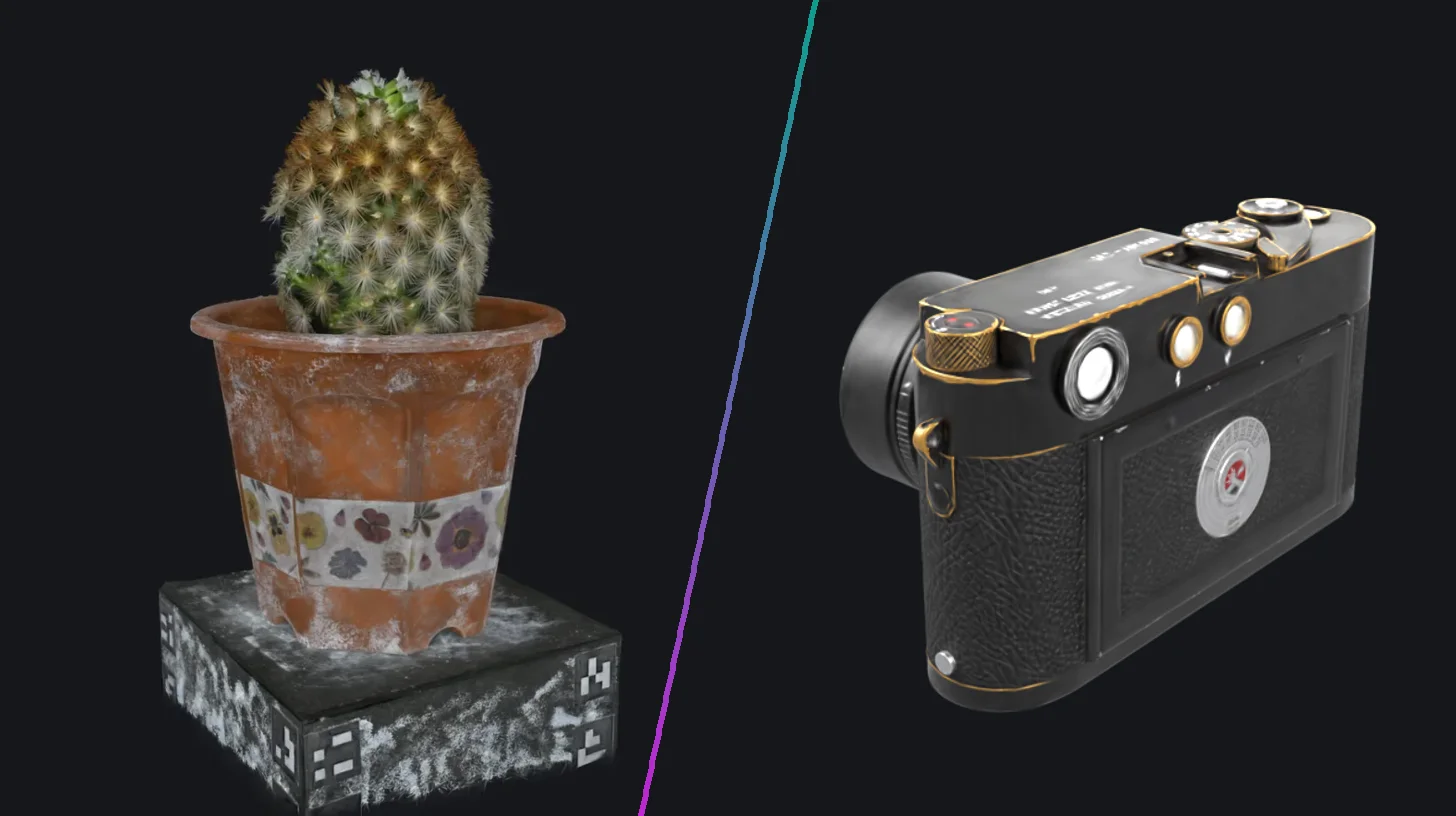
Open a Gaussian splat and nothing tells you where it came from. The file holds the same thing every time — a cloud of small, soft, coloured ellipsoids — whether they were learned from 400 photos of a real object, from renders of a 3D model that was never built, or dreamed up by an AI from one sentence.
Yet those three splats do not prove the same thing. A real splat, captured from the world, shows what was there. A synthetic splat shows what someone designed, or what a model found plausible. For a museum, a building site or a product sheet, that difference is the whole point.
Where a splat comes from
Our cactus (427 photos), heritage sites, real estate tours, digital twins of factories.
Real Captured
Trained on photos, video or LiDAR of something that exists.
- Real geometry — Yes —Recovered from the photos: the shape is the subject’s.
- Real light — Yes —The light that was really there — baked in, not adjustable.
- True scale — Partly —Exact only with LiDAR, RTK or surveyed markers.
- Every side known — Partly —Only what the photos saw; the rest is a guess.
- Time to make — Partly —Hours to weeks, from shooting to delivery.
- Clear rights — Yes —Your photos — with permission for the place and the people in it.
Product visualisation, unbuilt architecture, film and game sets — our camera below.
Synthetic Baked from CG
A 3D model rendered by virtual cameras, then trained like a photo shoot.
- Real geometry — Yes —The model’s, exactly — as far as the renders show it.
- Real light — Partly —The render’s light, path-traced if you like, then frozen.
- True scale — Yes —The model’s units: nothing to estimate.
- Every side known — Yes —Virtual cameras can go anywhere, inside included.
- Time to make — Partly —Minutes to hours of rendering, then training.
- Clear rights — Yes —Those of the model: a licence to check, once.
Game assets, catalogues of existing 3D models, placeholders for a scene.
Synthetic Converted from a mesh
Each piece of a textured mesh turned directly into Gaussians, with no rendering.
- Real geometry — Yes —The mesh’s, point for point.
- Real light — No —No lighting is computed: only the textures’ colours.
- True scale — Yes —The model’s units.
- Every side known — Yes —Every surface of the mesh.
- Time to make — Yes —Under a millisecond per mesh with EA’s Mesh2Splat.
- Clear rights — Yes —Those of the model.
Concept worlds, moodboards, backgrounds, a first draft of an object from one photo.
Synthetic Generated by AI
A model imagines the splat from a prompt, a photo or a sketch of the layout.
- Real geometry — No —Plausible, not measured: invented where nothing was seen.
- Real light — No —Imagined along with everything else.
- True scale — Partly —Estimated at best — some models predict it, none measure it.
- Every side known — No —Unseen sides are hallucinated, sometimes differently each time.
- Time to make — Yes —Seconds to minutes.
- Clear rights — Partly —Depends entirely on the model’s licence — see below.
Four origins of a Gaussian splat — captured from the real world, baked from a 3D model, converted from a mesh, generated by AI — each with an animated drawing and six guarantees rated yes, partly or no, with the reason.
Four origins, one format. The first is the only one that starts from the physical world; the other three are synthetic, from a known model or from nothing but a prompt. Each rating is explained in the text below.
Real splats: captured from the world
A real splat is trained on photos, video or LiDAR scans of something that exists. It is the method of the original 2023 paper, and the one described step by step in our production workflow: shoot the subject from every side, find where each photo was taken, then optimise the Gaussians until they reproduce every photo.
Its strength is that the shape and the light come from the subject itself. The cactus in the first article of this series has 427 photographs behind it; each spine is where it is because the photos put it there. Its limits are those of the capture: what the photos did not see, the splat invents; its scale is only true if the capture fixed it, with LiDAR, satellite positioning or surveyed markers; and the light is the light of the day, baked in.
Capture hardware is now built for it. XGRIDS’ Lixel L3, shown in September 2026, produces a point cloud, a mesh and a splat from a single walk, with an announced accuracy of a few millimetres. And industry uses real splats as test grounds: NVIDIA’s Omniverse NuRec, generally available since spring 2026, reconstructs real streets and warehouses as splats to train robots and self-driving cars in simulation.
The method that started it all, presented by its authors at Inria in 2023: real scenes, captured in photos and rendered in real time.
Video: GraphDeco Inria Research Group, on YouTube.Synthetic splats from a 3D model
Why turn a 3D model into a splat, when the model already exists? For the same reason a photograph of a product is easier to show than the product: a splat freezes an expensive render into something cheap to display. Soft shadows, reflections, global illumination, all the work of a path tracer, end up stored in the colours of the Gaussians — and play back in a phone’s browser at the cost of an ordinary splat.
There are two ways to do it.
Virtual capture. You render the model from hundreds of virtual cameras whose positions you know exactly, then train a splat on those renders as if they were photos. Tools now automate it: Atlux in Unreal Engine, the SplatWorks add-on in Blender. Knowing the cameras exactly matters: synthetic renders, with their plain backgrounds and no sensor noise, are often too clean for the structure-from-motion software that locates real photos.
Direct conversion. Some tools skip rendering altogether and turn each piece of a textured mesh straight into Gaussians. Electronic Arts’ research lab published Mesh2Splat, which converts a model in under half a millisecond on average; the result keeps the textures’ colours but none of the lighting a render would have added, and the method does not handle hair, foliage or clouds.
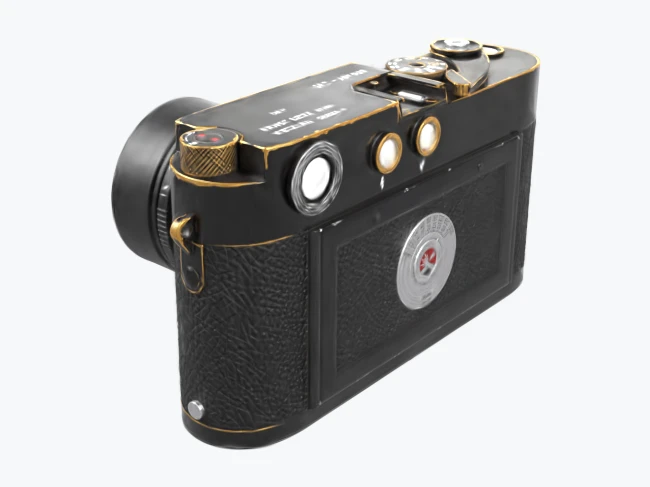
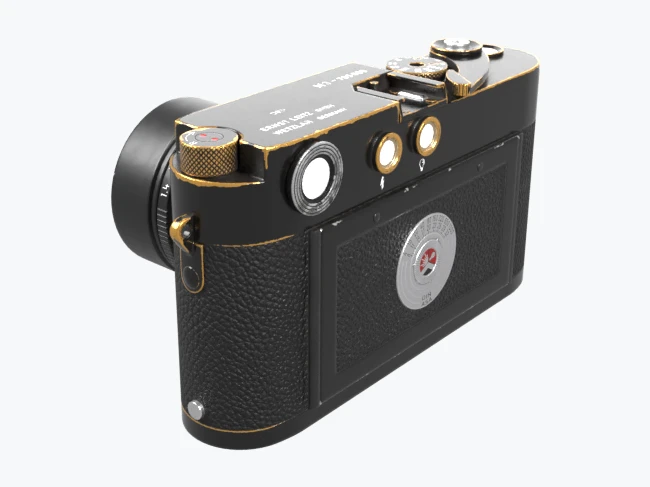
We tried the first route on a free 3D model of a camera from Poly Haven: 200 renders in Blender, a splat trained on a desktop Mac, then compared with Blender from a viewpoint the training never saw.
A splat baked from a 3D model, by us
The bake, measured
- Training views
- 200 renders, 800 px
- Training on an Apple M4
- 19 minutes
- Gaussians
- 43,192
- Quality on unseen views
- 32.7 dB PSNR
- Raw PLY
- 10.2 MB
- SOG for the web
- 1.6 MB
Model: “Camera 01” by Rajil Jose Macatangay, Poly Haven, CC0 (strap removed). Rendered with Blender Cycles; trained with Brush on an Apple M4.
The same viewpoint twice: a Blender Cycles render of a free 3D model of a camera, and the Gaussian splat trained on 200 other renders of it, seen from that viewpoint it never saw. A slider moves the split between the two.
Slide the split: the splat reproduces the render almost exactly, down to the brass on the dials, from a viewpoint it had to work out for itself. The difference shows in the finest engravings and the grain of the leather, a little softer. Over the twelve viewpoints kept out of training, the splat scores 32.7 dB of PSNR against Blender — above 30 dB, differences are hard to see without looking for them. The whole bake ran on an ordinary Mac with an Apple M4 chip: about an hour of rendering (212 images), then 19 minutes of training. And 43,192 Gaussians are enough for an object this size: the web version, in SOG, weighs 1.6 MB.
The price of this realism is that the light is frozen. A baked splat does not react to the scene around it: it receives no shadows and reflects nothing new. And every variation is a new splat: as a 2026 automotive industry newsletter put it, “nobody’s cracked configurable splats yet” — each paint colour of a car configurator means another bake.
Synthetic splats generated by AI
The second family of synthetic splats has no model to start from. A generative model imagines the splat from a prompt, a photo or a rough layout, in seconds or minutes.
For objects, TRELLIS, from Microsoft, outputs Gaussians or a mesh from an image or a text; Meta’s SAM 3D Objects reconstructs the whole of an object — including its hidden side — from a single photo, and powers the “View in Room” feature of Facebook Marketplace. The trend is telling, though: TRELLIS.2, at the end of 2025, abandoned splats for meshes with physically based materials, easier to relight and to use in engines.
For worlds, splats have won. World Labs’ Marble, commercially available since November 2025, generates explorable scenes from a text, images or a video and exports them as splats of about two million Gaussians. NVIDIA’s Lyra distils a video generation model into a splat decoder; Apple’s SHARP turns a single photo into a splat in under a second.
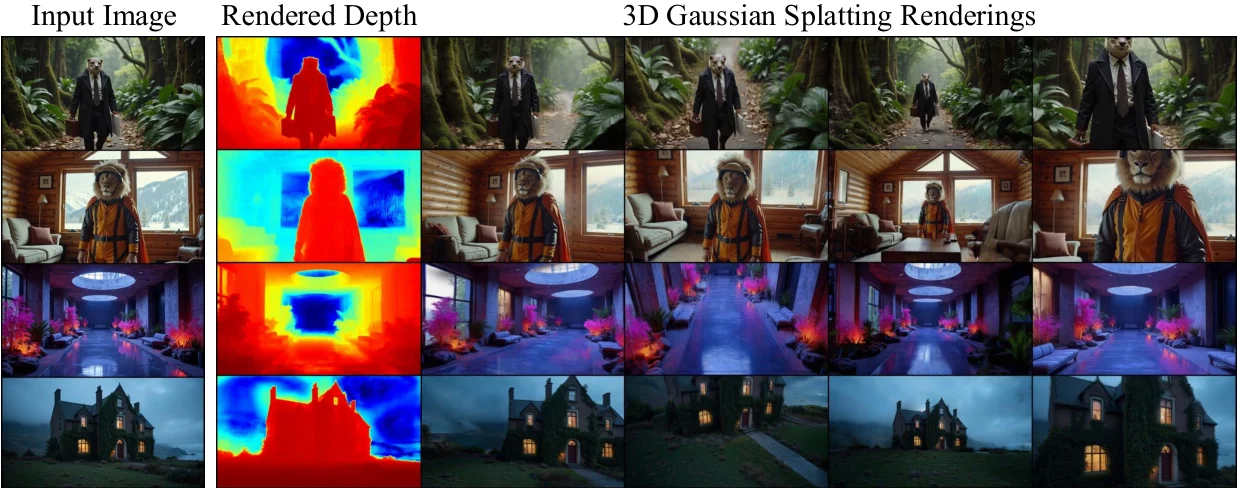
One image in, a 3D scene out: NVIDIA’s Lyra generates the splat from a single picture, then lets you look around. Everything outside the original frame — the sides, the back, the ceiling — was invented.
Image: Bahmani, Shen, Ren et al., NVIDIA — “Lyra: Generative 3D Scene Reconstruction via Video Diffusion Model Self-Distillation”, CC BY 4.0, via arXiv:2509.19296 (figure 1, top half, converted to WebP).That is the essential limit: a generated splat is plausible, not true. What the prompt or the photo did not show, the model makes up, and it can make it up differently each time — the authors of Lyra 2.0 call it “spatial forgetting”, when an area you come back to has been re-imagined. Some models estimate a scale, none measures one. Nobody should take a measurement from a generated splat.
World Labs presenting Marble at its commercial launch, in November 2025: worlds generated from a text or an image, exported as Gaussian splats.
Video: World Labs, on YouTube.The line is blurring
In practice, the two families mix more and more. NVIDIA’s Difix3D+ cleans up a real capture by letting a generative model repaint the areas the photos saw badly: a real splat with invented patches. Marble and Tencent’s HY-World accept real photos and video as well as prompts, and blend reconstruction with generation in the same product. In the other direction, V-Ray and Octane now relight and path-trace captured splats inside 3D scenes, and Niantic announced relighting for splats in September 2026.
So the useful question is no longer “real or synthetic?” but “which parts were observed, and which were computed or invented?”
The licences decide
For an agency, the most discriminating criterion is often not technical. Many generative models are published for research, or exclude Europe outright.
Can an agency use it?
| Tool | In | Out | Commercial use (EU) |
|---|---|---|---|
| TRELLISMicrosoft | An image or a text | Gaussians (PLY), mesh | YesMIT licence, code and weights. |
| TRELLIS.2Microsoft | An image | PBR mesh (GLB), no splats | With conditionsMIT licence, but the project page adds a research-only notice: check before production. |
| SAM 3D ObjectsMeta | One photo | Gaussians (PLY), mesh | With conditionsSAM Licence: commercial use allowed, except military, weapons and trade-controlled uses. |
| SHARPApple | One photo | Gaussians (PLY) | NoModel weights for non-commercial research only. |
| LyraNVIDIA | A text or one image | Gaussians | With conditionsCode under Apache 2.0, weights under the NVIDIA Open Model License: read its terms. |
| Lyra 2.0NVIDIA | A text or one image | Gaussians, mesh | NoWeights under an internal research licence; a custom licence on request. |
| HY-World 2.0Tencent | Text, images, video | Gaussians, mesh, point cloud | NoThe licence does not apply in the EU, the UK or South Korea. |
| Hunyuan3D 2.1Tencent | An image | PBR mesh, no splats | NoSame territorial exclusion: EU, UK, South Korea. |
| MarbleWorld Labs | Text, images, video, a 3D layout | Gaussians (PLY, SPZ), mesh | With conditionsPaid plans: you own the outputs; free plan: personal use. AMD announced on 28 September 2026 that it will acquire World Labs. |
| Mesh2SplatElectronic Arts (SEED) | A textured mesh (glTF) | Gaussians | YesBSD-3 licence (modified only for EA’s logos). |
A table of ten tools that create Gaussian splats or 3D models from a model or by AI: what goes in, what comes out, and whether their licence allows commercial use by a company in the European Union. Filters keep only the tools that output splats, or only those usable commercially.
Checked against each licence in September 2026. Licences change: read the current version before a project, and keep in mind that a model’s licence governs its outputs too. Tencent’s community licences, for instance, do not apply in the European Union, so a French company cannot use those models or show what they produce.
Telling them apart, and saying so
Nothing in a splat file records its origin: the new glTF standard for splats, KHR_gaussian_splatting, has no field for it, and the C2PA content credentials used for photos and videos do not yet cover 3D formats. Researchers work on watermarking splats, not on telling a captured one from a generated one.
The law is moving faster. Since 2 August 2026, Article 50 of the European AI Act requires AI-generated images and videos to be marked as such, and its definition of a deepfake covers content that resembles existing people, objects or places and would falsely appear authentic. 3D is not named; views and videos rendered from a splat plausibly are. Our reading, not legal advice: a generated splat of a real place or product, shown as if it were real, is exactly the risky case — label it.
Which one for which project?
- To show what exists — a heritage site, a property for sale, a shop, an event, a product that is already made: a real capture. It is the only one that proves anything.
- To show what does not exist yet — a product still in design, a building not yet built, a set, a configurator: a bake from the 3D model, which keeps exact geometry and the quality of a path-traced render.
- To explore ideas fast — a concept, a moodboard, a background world, a first draft from a photo: generation, with a licence checked beforehand and a clear label.
At ARGO
We choose the origin according to what the experience has to prove. A packaging or a showroom seen through a phone should be the real thing, captured; a product that will only exist next season can be baked from its CAD model; generation is for sketches and scenery — never for passing off as a record. And whatever the origin, the splat ends up the same way: compressed, opened in the browser, with no app to install.
FAQ
Frequently asked questions
Sources and further reading
- Kerbl et al., 3D Gaussian Splatting for Real-Time Radiance Field Rendering, SIGGRAPH 2023 — arXiv:2308.04079 · NVIDIA, Omniverse NuRec
- Virtual capture and conversion: Atlux · SplatWorks · Electronic Arts SEED, Mesh2Splat
- Generation: Xiang et al., TRELLIS, arXiv:2412.01506 · Meta, SAM 3D · World Labs, Marble · Bahmani et al., Lyra, arXiv:2509.19296 · Apple, SHARP · Tencent, HY-World 2.0
- Hybrids: NVIDIA, Difix3D+, arXiv:2503.01774
- Regulation: European Commission, Transparency obligations under Article 50 of the AI Act · C2PA specification 2.4
- The model baked in this article: Rajil Jose Macatangay, Camera 01, Poly Haven, CC0
Licences, products and statuses checked in September 2026.