
Supercomputers, AI and Sovereignty: The Future Beyond Models

When China Reclaims the Top of Global Computing
The latest TOP500 ranking marked a symbolic turning point: China’s LineShine supercomputer, installed in Shenzhen, became the most powerful system in the world on the HPL benchmark, surpassing major American machines such as El Capitan, Frontier and Aurora.
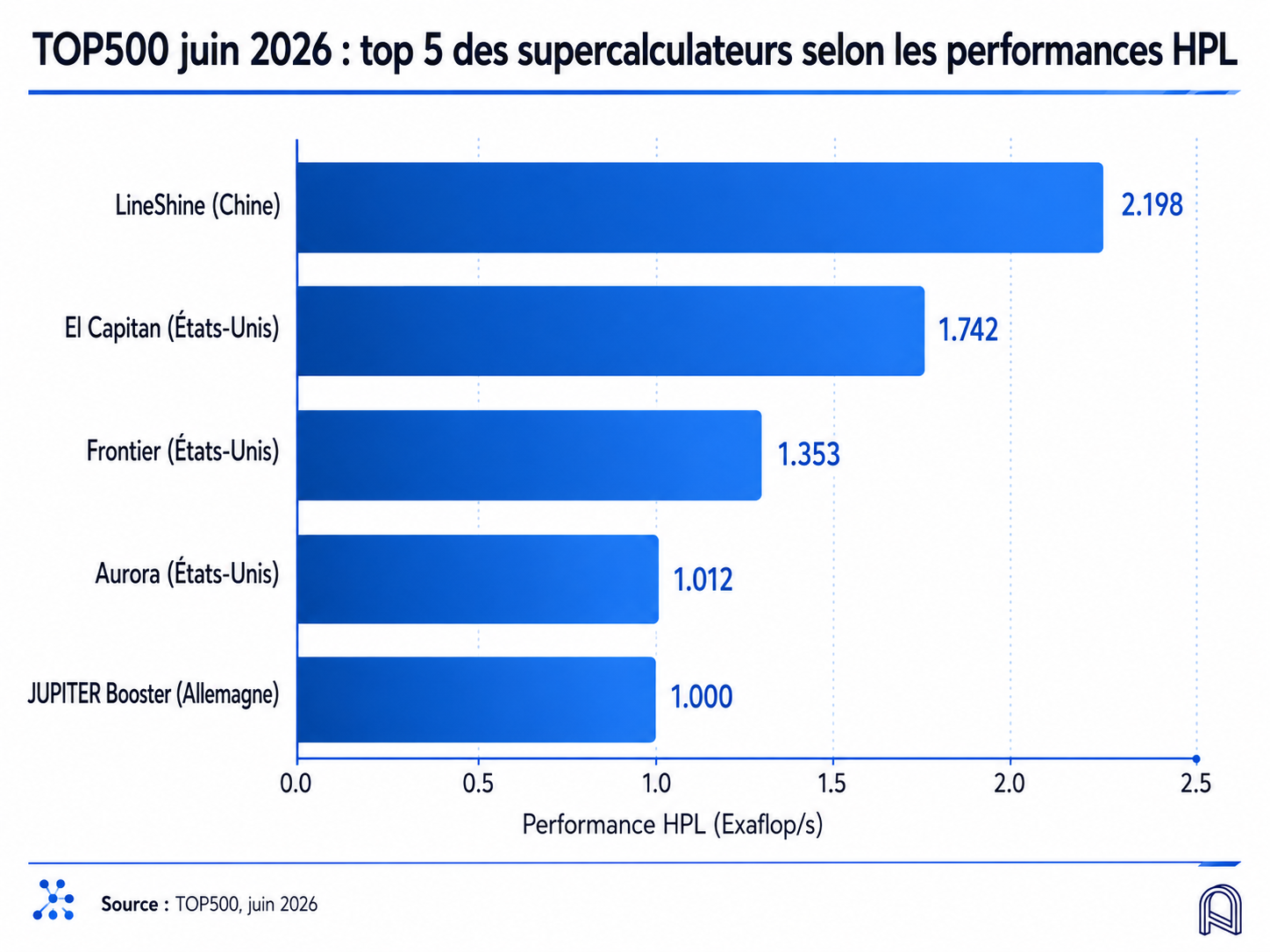
Beyond the spectacular figure — over two exaflops of sustained performance — the most interesting piece of information may not be the raw power. It lies in the system’s architecture: LineShine runs on Chinese processors, a proprietary interconnect, a Chinese operating system, and a design largely independent of the Western GPUs that dominate today’s generative AI.
For China, this is a strong political and industrial signal. For enterprises, it is above all a reminder: in the age of artificial intelligence, performance no longer depends solely on the model used. It depends on the entire system surrounding it.
The Ranking Trap: Raw Compute Does Not Equal AI Power
One must avoid an overly simplistic reading. Being number one on the TOP500 does not automatically mean being number one in artificial intelligence.
The TOP500 ranking has historically relied on the HPL benchmark, designed to measure high-precision scientific computing performance. It is a major indicator for simulation, research, weather forecasting, physics, and engineering. But the workloads of modern AI — training large models, real-time inference, image generation, multimodal processing — often rely on different types of computation, particularly mixed-precision calculations, highly optimised for GPUs and specialised accelerators.
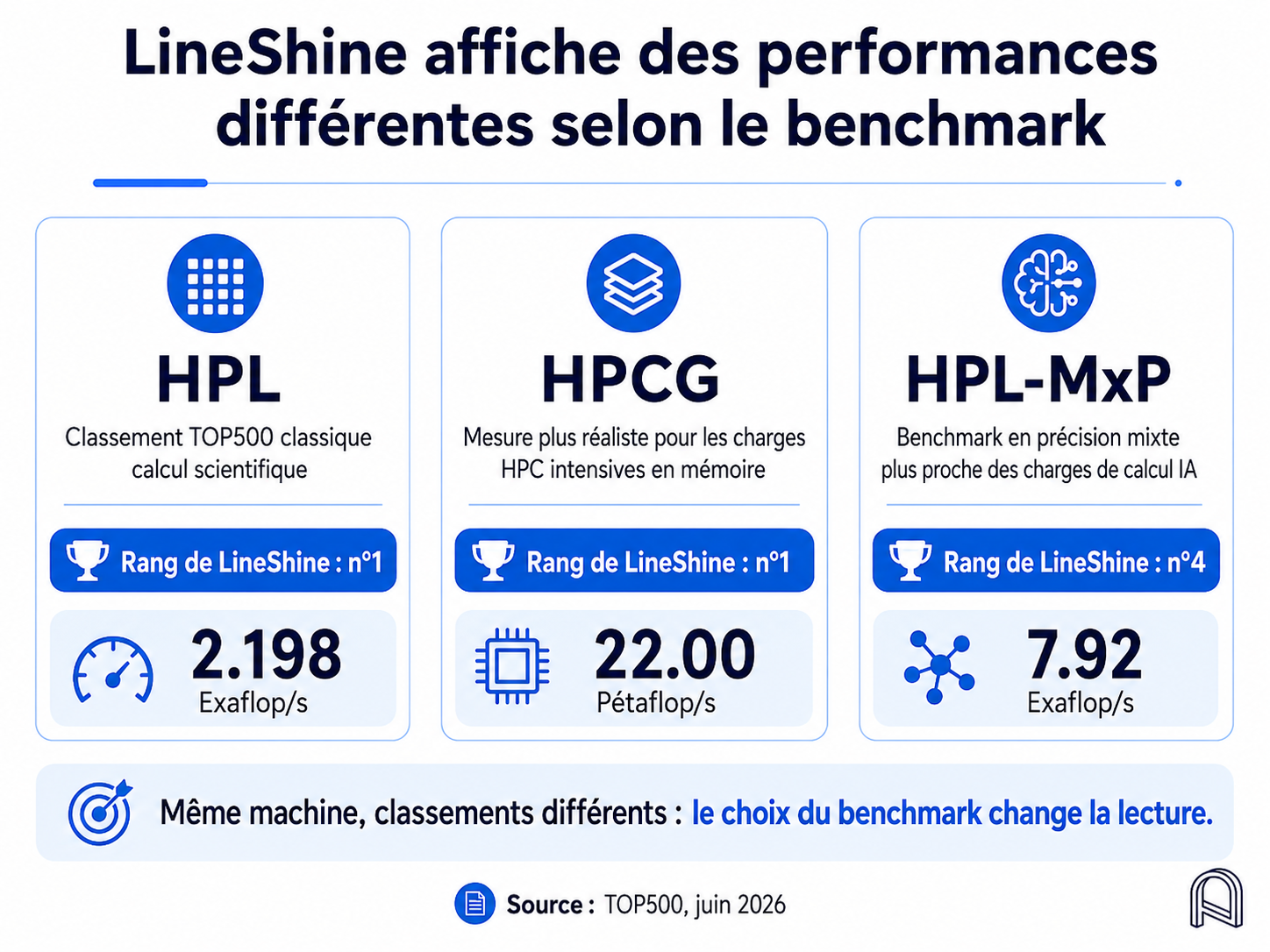
This is where the signal becomes interesting: LineShine demonstrates that a sovereign architecture can reach an exceptional level of raw performance, but this does not mean it automatically replaces the cloud and GPU infrastructures used by OpenAI, Google, Anthropic, Meta, or xAI for generative AI.
The real lesson is more subtle: there is no longer a single technological race. There are several running in parallel.
- The scientific computing race.
- The AI models race.
- The cloud infrastructure race.
- The energy efficiency race.
- The data sovereignty race.
- The race to build interfaces capable of making these technologies useful for end users.
And it is precisely on this last front that enterprises need to focus their attention.
From Raw Power to Useful Experience
For a long time, technological innovation was narrated as an accumulation of power: more processors, more data, more parameters, more compute.
But for a brand, a manufacturer, a player in retail, healthcare, training, or culture, the question is not: “What is the largest model?” or “What is the biggest supercomputer?”
The real question is: “What experience does this technology make possible?”
An AI only has value if it is integrated into a clear, accessible, and measurable journey. Augmented reality only has impact if it simplifies a decision, enriches a product, trains a user, engages a visitor, or transforms a physical medium into a digital entry point.
This is where the notion of system becomes essential.
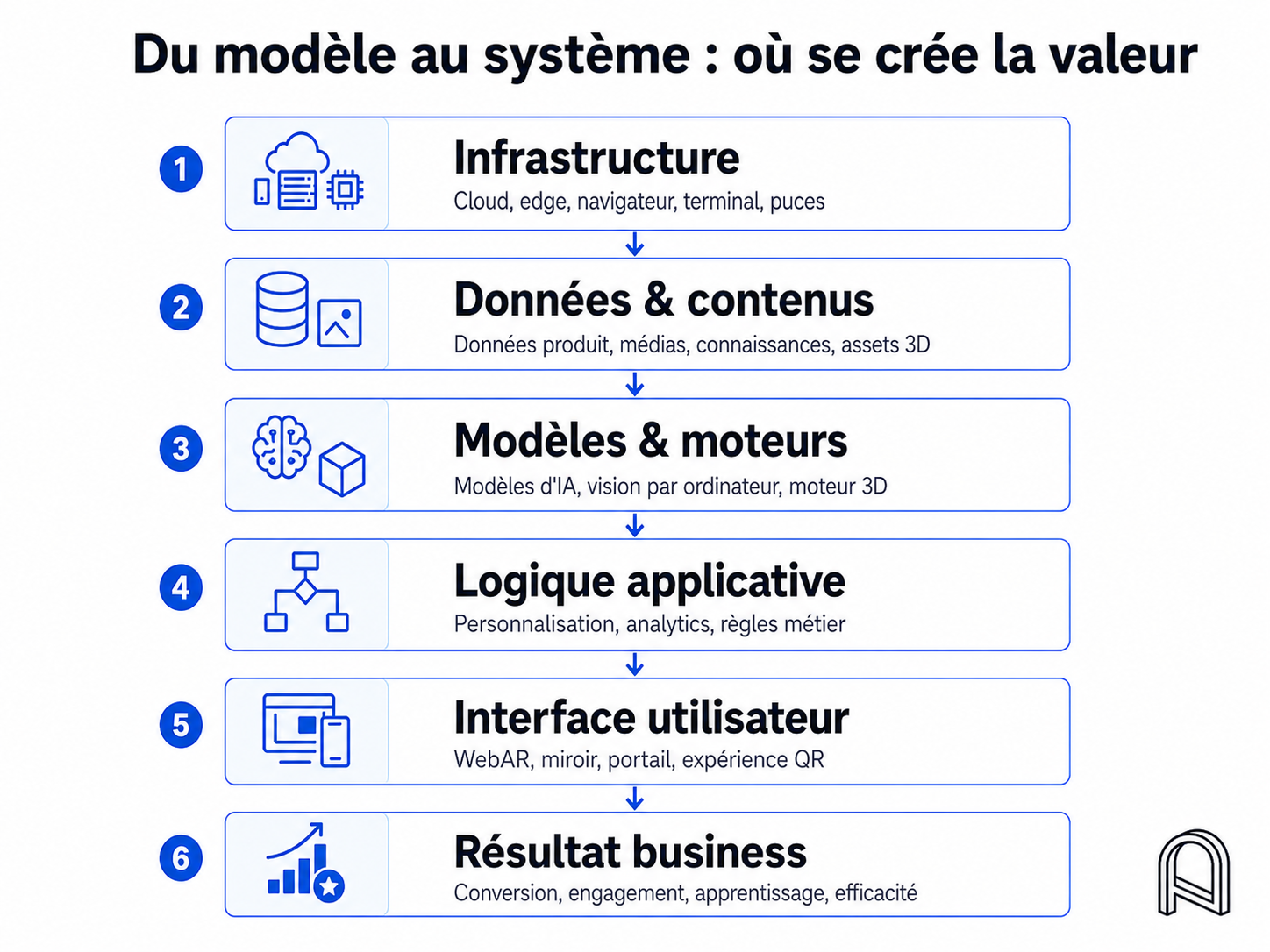
A high-performing AI or immersive project does not rest solely on a model. It rests on a complete chain:
- the available content;
- the exploitable data;
- the right model or recognition engine;
- the user interface;
- the distribution context;
- device compatibility;
- performance measurement;
- security;
- the capacity to evolve over time.
Technology is no longer an isolated block. It becomes an experience architecture.
Sovereignty Does Not Mean Doing Everything Yourself
The LineShine example is also interesting because it brings technological sovereignty back to the centre of debate. But for enterprises, sovereignty does not necessarily mean building your own chips, your own models, or your own data centres.
Operational sovereignty means knowing what you control, what you delegate, and what you must be able to replace.
In an AI or AR project, this can mean:
- avoiding excessive dependence on a single vendor;
- designing experiences accessible from the browser, without requiring an app download;
- retaining control over collected data;
- choosing between cloud, edge, or local compute based on constraints;
- being able to switch AI models without rebuilding the entire experience;
- separating the interface layer, the content layer, and the intelligence layer.
This logic is particularly important for brands deploying experiences in real environments: stores, trade shows, museums, events, points of sale, packaging, printed materials, professional portals, or training journeys.
In these contexts, the best technology is rarely the most impressive on paper. It is the one that actually works, at the right moment, on the right device, for the right user.
Why This Matters for Augmented Reality and Immersive Experiences
Augmented reality, WebAR, interactive mirrors, and spatial interfaces are directly affected by this evolution.
These experiences combine several technology layers: image recognition, face or body tracking, segmentation, real-time 3D, generative AI, analytics, web hosting, mobile compatibility, QR codes, CMS, CRM, or e-commerce.
In other words, they are already systems.
A Magic Mirror in a store is not just a camera and a screen. It must detect a presence, understand a gesture or a face, apply a visual effect, display relevant content, comply with privacy constraints, measure engagement, and sometimes connect the experience to a purchase journey.
A WebAR experience from a QR code is not just a 3D model. It must load fast, work without a download, adapt to mobile browsers, tell a story, and turn a brief interaction into measurable engagement.
An interactive document or augmented portal is not just an interface. It must structure information, guide the user, integrate media, track usage, and allow the organisation to continuously improve its content.
In all of these cases, the challenge is not just AI or AR. The challenge is orchestration.
The Future Belongs to Hybrid Architectures
The story around LineShine also illustrates a deeper trend: the digital future will be hybrid.
Some tasks will remain on large clouds or supercomputers. Others will run locally, on specialised machines, smartphones, kiosks, glasses, or in-store devices. Some experiences will use very powerful remote models. Others will favour lighter, faster, more economical models — or ones better suited to privacy constraints.
For enterprises, this changes how a project is conceived.
It is no longer about choosing “the best model” in the abstract. It is about choosing the right architecture for the right use case.
- A sales assistant in a store does not have the same constraints as a video generation engine.
- An event AR experience does not have the same constraints as a technical portal for professionals.
- An interactive mirror does not have the same constraints as an immersive training module.
- Augmented packaging does not have the same constraints as an internal decision-support tool.
The right system is the one that balances performance, cost, accessibility, security, user experience, and deployment capacity.
The Lesson for Brands: Think System Before Tool
The global race for supercomputers may seem very distant from marketing, retail, or communication challenges. In reality, it tells the same transformation story at a different scale.
The winners will not simply be those who use the most powerful model or the most recent technology. The winners will be those who know how to assemble the right building blocks to create useful, robust, and differentiating experiences.
For a brand, this means moving from a technology demonstration logic to an experience system logic.
It is not “doing AI” that creates value. It is integrating AI into a clear journey.
It is not “doing augmented reality” that transforms an interaction. It is connecting the physical medium, the digital content, the user, and the data.
It is not “using an advanced model” that guarantees performance. It is designing an architecture capable of functioning under real field conditions.
Conclusion: AI Enters the Age of Systems
China’s return to the top of the TOP500 is an important technological event. But for enterprises, its main lesson lies elsewhere: innovation is no longer solely a question of power. It is becoming a question of architecture.
Models matter. Chips matter. Infrastructure matters. But the interface, the context, the data, the use case, and the experience matter just as much.
At ARGO, this conviction guides our approach: designing augmented experiences that do not simply use a technology, but integrate it into a complete, accessible, and measurable system.
Because the future of AI and augmented reality will not be defined solely by the most powerful machines.
It will be defined by the most useful experiences.