
Atlas by World Labs: When AI Stops Making Videos and Starts Making Worlds
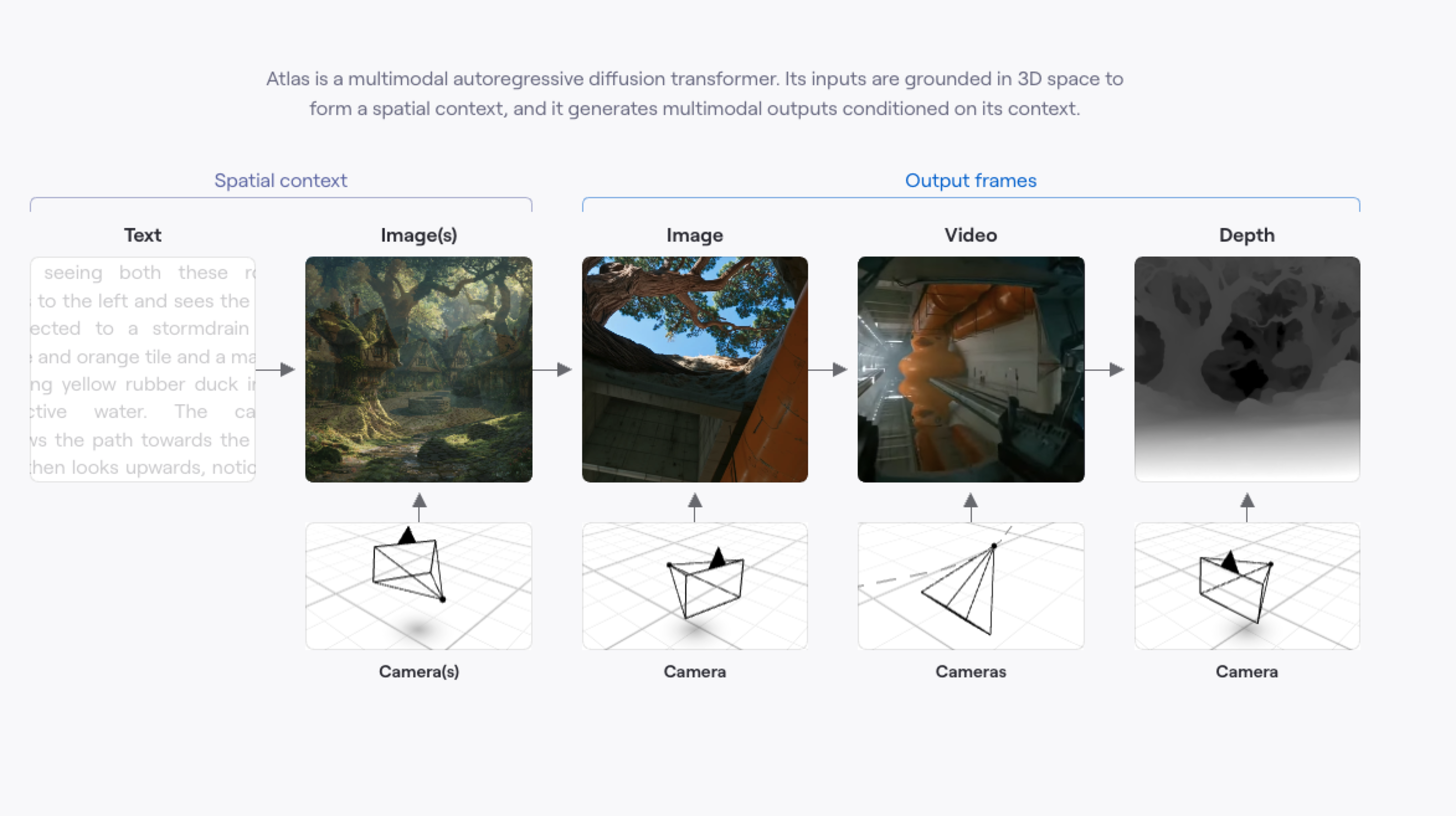
World Labs just unveiled Atlas, an “omni world model” that generates a full minute of 1440p video with pixel-perfect camera control — and reconstructs the scene in 3D while it’s at it. Another video generator? No. A shift in what “generating” means: from producing pixels to modelling space itself.
The launch that redraws the map
On September 1, Fei-Fei Li’s World Labs introduced Atlas, the successor logic to Marble (November 2025) and the World API (January 2026). The pitch is deceptively simple: give Atlas one or a few reference images, hand it a camera trajectory, and it generates new views of that scene from any position and angle you specify — consistent with the input geometry, smoothly extrapolating what the cameras never saw.
Under the hood, Atlas is a multimodal autoregressive diffusion transformer: a single model that natively ingests and produces text, images, video and 3D data — including point clouds and Gaussian splats as explicit outputs.
Three capabilities stand out:
Pixel-perfect camera control. Where Sora-class generators interpret vague text prompts (“slow dolly-in, please”), Atlas takes camera trajectories and geometry as native inputs. You don’t describe the shot. You direct it.
Generation and reconstruction in one model. The same system that imagines unseen parts of a scene also outputs its explicit 3D structure — reportedly beating top open-source reconstruction models from sparse inputs. The more images you feed it, the less it invents.
Space-time simulation. From a handful of ordinary phone cameras, Atlas rebuilds dynamic scenes — reframing footage, freezing “bullet time” moments, and generating the photorealistic RGB and depth data a robot’s sensors would need. Real-to-Sim, from casual recordings.
Why this is more than a better video model
The video-generation race has been about fidelity: sharper frames, longer clips, fewer melting hands. Atlas competes on a different axis: spatial coherence. A world model doesn’t predict the next frame — it maintains a consistent 3D scene and renders views of it.
That distinction is everything for anyone who works, as we do, in augmented reality and 3D experiences. A beautiful but geometrically unstable video is unusable in AR. A scene with explicit geometry — splats, point clouds, depth — is an asset you can anchor, walk around, and interact with.
We wrote last November that Marble, SAM 3D and WorldGen were converging toward democratised 3D creation. Atlas is that convergence, industrialised: one model, one spatial framework, every modality.
What it could change
The end of the 3D capture bottleneck
Today, producing a usable 3D scene means photogrammetry rigs, LiDAR scans or hours of splat optimisation. If a few casual photos are enough to obtain a navigable, photorealistic reconstruction, the cost of digitising a boutique, a monument or a showroom collapses. Virtual tours, cultural mediation, retail staging: the scarce resource is no longer capture — it’s intent.
Directed video, not prompted video
For brands, the difference between “describe a camera move and hope” and “specify the exact trajectory” is the difference between a slot machine and a production tool. Product films, architectural fly-throughs, event teasers: camera control turns generative video from a creative lottery into a repeatable pipeline.
Splats as the exchange format
Atlas outputs 3D Gaussian splats natively — the same representation that already renders in real time in a browser. That matters: it means the frontier of generation is aligning with the frontier of delivery. A world generated in the cloud can be explored on a smartphone, via a link, with nothing to install.
Robotics and digital twins for the rest of us
Real-to-Sim workflows — reconstructing a real space, then simulating sensors and movement inside it — used to belong to industrial labs. If a few photos suffice, training environments, safety walkthroughs and store-layout simulations become accessible to mid-sized players.
The obstacles, because there are some
Let us stay clear-eyed. Atlas launched into early access only, with unnamed partners, no paper, no model card, no price. Every benchmark win was measured by World Labs itself — and in the camera tests, Atlas received native trajectories while rivals got text descriptions of the intended moves, a comparison the company itself concedes is imperfect. The model is proprietary and cloud-bound: no local weights, no self-hosting, full dependency on one vendor’s API and pricing decisions yet to come.
None of this invalidates the demonstrated capabilities. But between a spectacular launch post and a production pipeline, there is a contract, an SLA and a cost per generation — and today, all three are blank.
The essential point: geometry becomes a language
For three years, generative AI has spoken in flat media: text, images, video frames. Atlas — alongside Odyssey’s interactive simulations, AMI Labs’ planning architectures and Niantic’s geospatial models — signals that 3D structure is becoming a native modality, not a post-processing step.
For years the question in generative media was:
“Which model produces the most convincing pixels?”
If world models deliver, the question of the coming years becomes:
“Who can turn any real place into an explorable, augmentable digital asset — and deliver it where people already are?”
The first half of that question is being answered by labs like World Labs. The second half is our terrain: everything ARGO builds runs in the browser, splats included, because the device already in someone’s hand is the best distribution channel there is. Atlas doesn’t compete with that logic — it feeds it. The worlds are about to get much cheaper to make. Getting people inside them, without an app, without friction: that remains the craft.
Sources: World Labs — Atlas announcement · SiliconANGLE · The Implicator